
Prolotherapy/Regenerative
Injection Therapy
Prolotherapy
/Regenerative
Injection Therapy
Prolotherapy/Regenerative Injection Therapy
At Prolotherapy Now, Dr. Ayo Bankole helps individuals heal from joint pain, ligament injuries and chronic pain conditions by using regenerative agents and injection techniques designed to restore function, not just mask symptoms.
Every treatment plan starts with understanding your injury and your goals, followed by a comprehensive orthopedic evaluation and a personalized approach built around the regenerative agents best suited to your condition.
TAKE THE NEXT STEP TO PAIN RELIEF!
What is Prolotherapy?
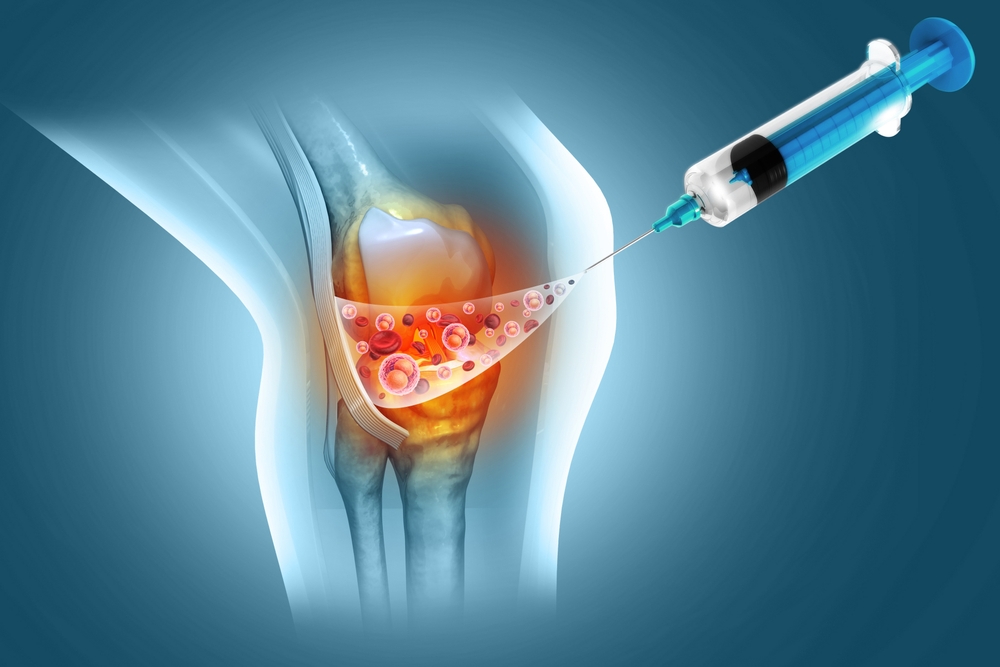
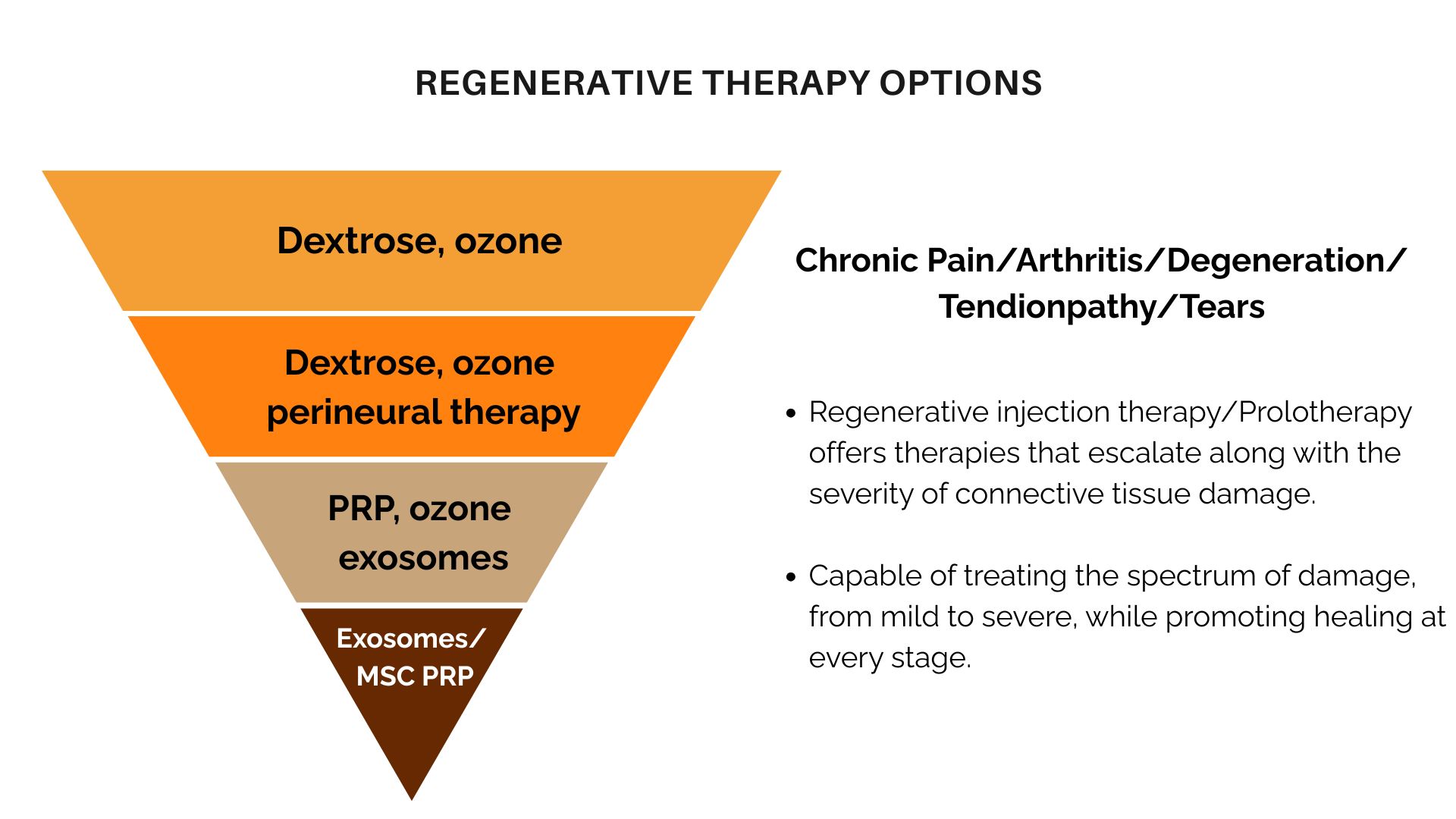
Prolotherapy, also known as Regenerative Injection Therapy, is a non-surgical, in-office procedure that helps restore function and heal from painful and injured joints. Prolotherapy addresses the site of injury, along with the surrounding structures. Prolotherapy owes its name to proliferation as treatments cause the proliferation of healing cells that repair connective tissue. These healing cells release collagen and matrix to repair stretched and torn ligaments, tendons and cartilage. A variety of formulas may be used in Prolotherapy and include dextrose and procaine alone or in combination with bio-cellular agents such as Platelet-rich Plasma and stem cells. No matter the formula used, injections of tendons and ligaments to stimulate healing and repair is Prolotherapy.
A Better Model for Understanding Chronic Pain
Prolotherapy takes account of the most accurate and current model of understanding chronic musculoskeletal pain. Chronic joint pain most commonly results from ligament and tendon dysfunction.
Read More →
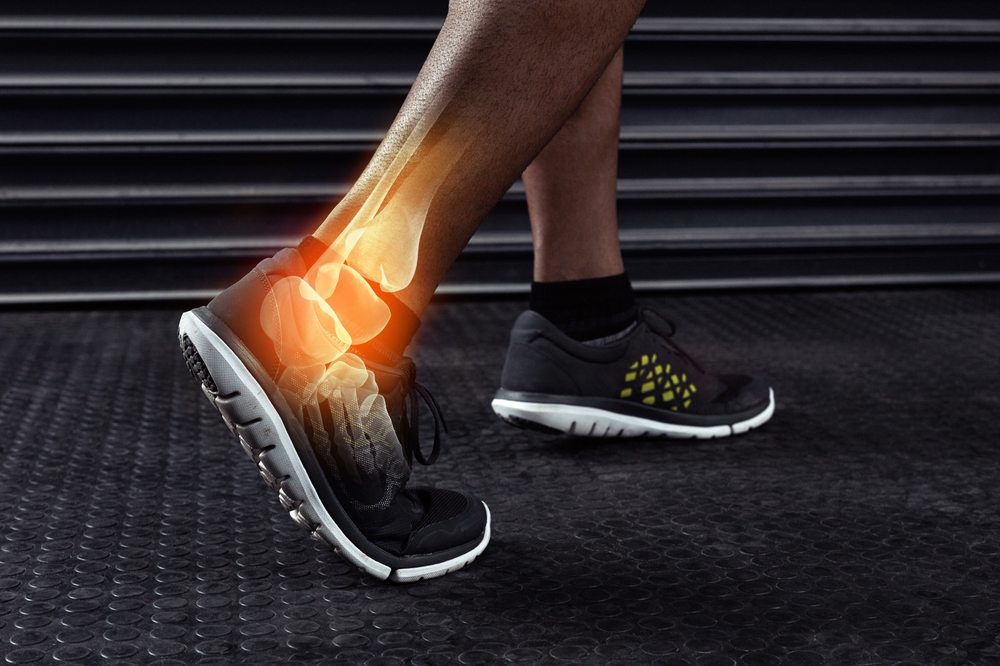
Weakened and lax connective tissue allows instability and the transference of unequal forces through especially weight bearing joints contributing to cartilage damage. Finally, nerves within the connective tissue and around the joint begin sending pain signals. Prolotherapy is simply the most effective treatment for healing and repairing deteriorated, damaged and arthritic joints.
Why Choose Prolotherapy
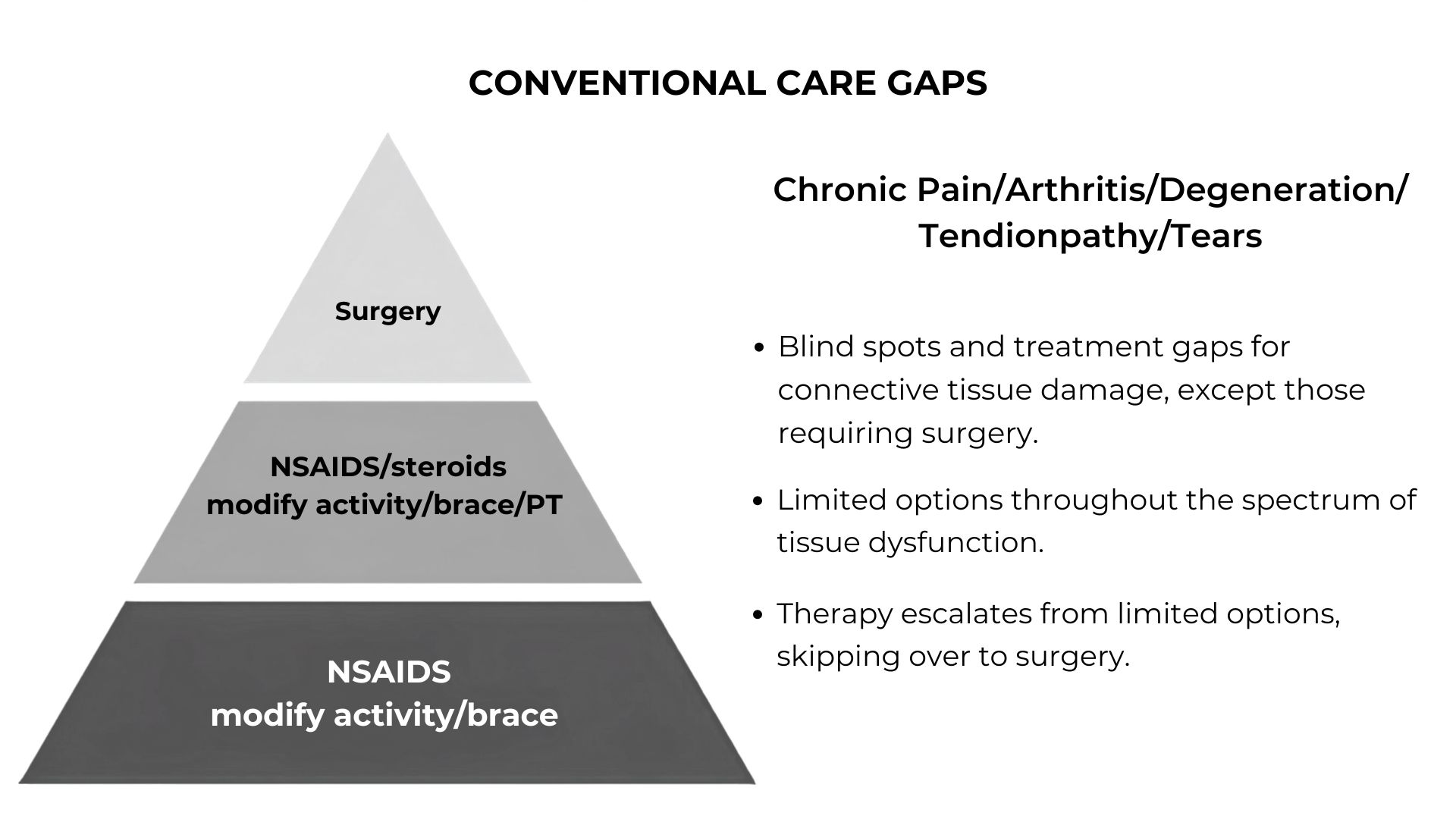
Conventional therapies lack the regenerative quality of Prolotherapy and therefore do not address the underlying instability and deterioration.
Read More →
Braces and support, pain medications, surgery, extended periods of immobility, and other similar approaches do nothing to stimulate healing. Worse, by blocking the release of healing cells disparately needed for repair, the common prescribing of non-steroidal anti-inflammatories and corticosteroid injections accelerate ligament deterioration that ultimately leads to more pain, and disability over time.
How Prolotherapy Works
Research spanning decades has found that the body responds to Prolotherapy just as with any injury; that is by stimulation of the wound healing cascade.
Read More →
Research spanning decades has found that the body responds to Prolotherapy just as with any injury; that is by stimulation of the wound healing cascade. This is your healing biology in action. The healing cascade begins with the release of messenger cells, signals and growth factors characteristic of the inflammatory response. Collectively, these signals recruit and send special cells called fibroblasts to the treated area. On arrival fibroblasts secrete collagen and matrix. This new collagen becomes incorporated into the injured ligaments and tendons to repair and strengthen them over time. Ultimately, the structural integrity of the joint is restored, function returns, and painful nerves stop firing.
Wound Healing Cascade
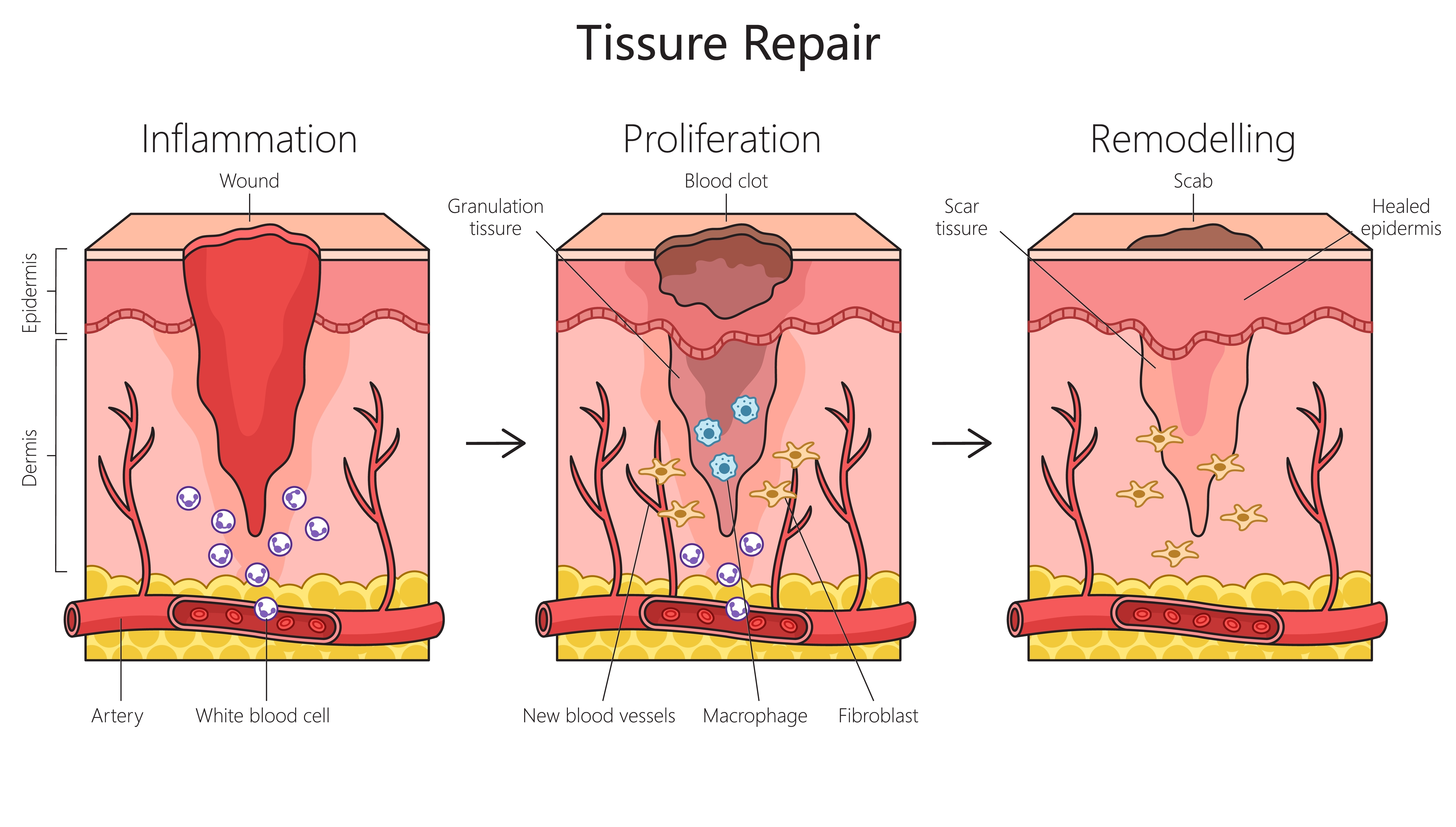
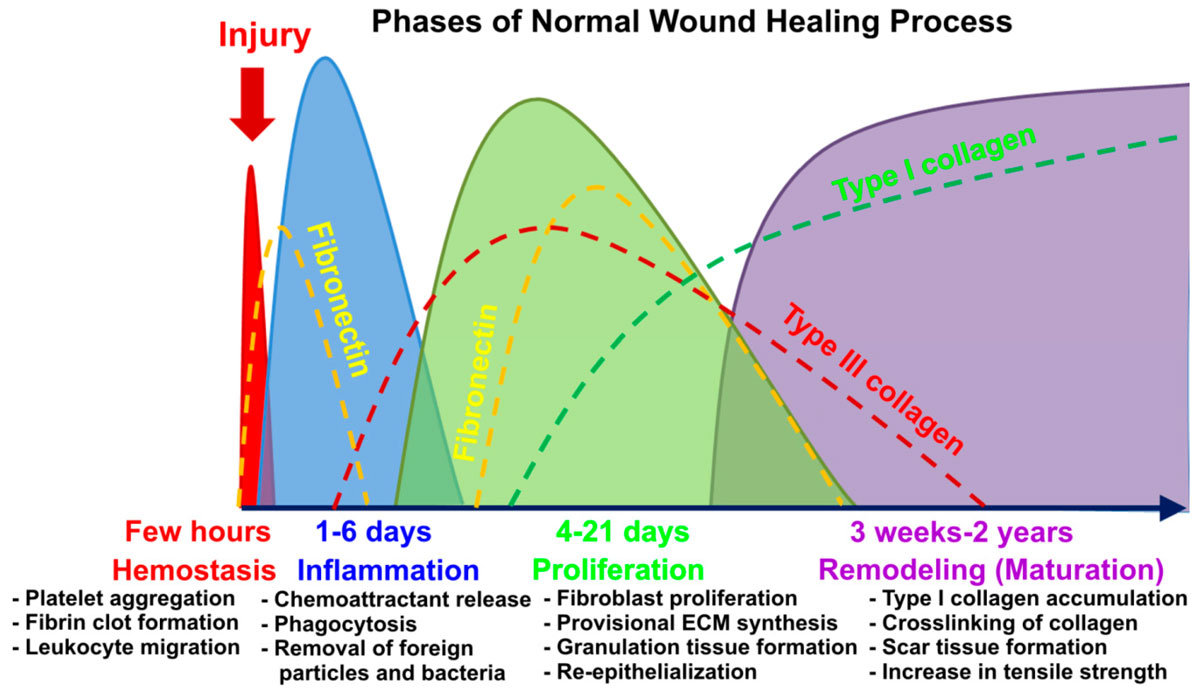
The best way to understand how and why Prolotherapy works is to be aware of the basics of wound healing. After a trauma, injury or surgery, the healing cascade is initiated to heal the wound. The wound healing cascade follows through distinct, sequential and partially overlapping stages. Prolotherapy works by simply exploiting the wound healing cascade.
| Wound Healing Cascade | Onset | Duration |
| Inflammatory Phase: Characterized by swelling, pain and warmth. The Injured tissue is exposed to proinflammatory substances and growth factors secreted by macrophages and platelets respectively. | Onset of injury | about 4 days |
| Proliferation Phase: The foundation of new tissue and blood vessel formation. Healing cells, most notably fibroblasts, produce collagen for wound repair. | 72 hours after injury | about 4 weeks |
| Remodeling Phase: Characterized by ongoing tissue regeneration and remodeling. Here collagen health and deposition continue as the wound’s strength and elasticity progresses. | 1-2 years |
Prolotherapy’s History
Prolotherapy was first performed in the early 1930’s. The earliest contemporary pioneer of the art was George S. Hackett, MD, a Cornell Medical School trained trauma surgeon. He is known as the “father of prolotherapy.”
Read More →
He is also credited with discovering that chronic ligament and tendon dysfunction is the most common cause of chronic joint pain. He, along with Earl Gedney, DO and David Shuman, DO were early pioneers who developed much of its methodology and were responsible for training other physicians in the early years. Gustav Hemwall, MD learned about Prolotherapy by a presentation Dr. Hackett gave at a medical conference in 1955. Dr. Hemwall went on to receive hands-on training from Dr. Hackett. Later, Drs. Hackett and Hemwall together devised the Hackett-Hemwall technique of Prolotherapy, the most widely taught and practiced method today.
The work and concepts developed by Dr. Hackett and others, along with the relationship between ligament and tendon dysfunction and chronic pain have now been well validated by research and case studies over the past few decades. Several post graduate training programs hold academic and hands-on conferences around the world for doctors wanting to learn Prolotherapy. Prolotherapy is now practiced by thousands of physicians who want to see their patients experience healing from chronic pain.
Dr. Gustav Hemwall M.D.
The Benefits of Prolotherapy
Musculoskeletal pain is one of the most common reasons people visit a doctor. Chronic joint pain increases with age, with nearly thirty percent of people aged sixty-five and older being affected. Conventional medicine leaves most joint pain sufferers no solution aside from chronic non-steroidal anti-inflammatory drugs, opioid dependence and surgery.
Read More →
Musculoskeletal pain is one of the most common reasons people visit a doctor. Chronic joint pain increases with age, with nearly thirty percent of people aged sixty-five and older being affected. Conventional medicine leaves most joint pain sufferers no solution aside from chronic non-steroidal anti-inflammatory drugs, opioid dependence and surgery. Most chronic joint pain sufferers would not benefit nor are candidates for surgery. On the other hand, Prolotherapy provides individuals a path to not simply have pain signals blocked but to actually have healthier, stronger joints and restored function. Most of all, Prolotherapy provides the opportunity for individuals to return to the activities they love. Treatments are helpful not only for chronic joint pain but for acute joint pain and injuries as well. Conditions treated include sprains and strains, tendonitis, tendinosis, arthritis, low back pain, tennis elbow, carpal tunnel syndrome, sciatica and others. Prolotherapy is proven to decrease or eliminate pain, to improve joint function and to provide a return to previous activity. In addition, prolotherapy gives individuals the opportunity to no longer rely on pain medications. Prolotherapy is beneficial to both young and older adults, and for athletes.
Conditions Treated

Regenerative Injection Therapy or Prolotherapy treats any form of musculoskeletal pain including osteoarthritis, sprains and strains, minor tears, repetitive use injuries, and those sustained by athletes. Treatments help new injuries or older ones that never healed properly.
- Ligament and tendon tears
- Arthritis
- Back pain
- Groin pain
- Joint laxity and hypermobility
- Tennis elbow, golfer’s elbow
- Pain and arthritis of the neck
- Knee pain
- Sacroiliac pain/dysfunction
- Neck pain
- Sciatica
- Rotator cuff injuries
- Pain at ischial tuberosity
- Shoulder pain
- Tendinosis